Market + AI Trend Intelligence
The State of AI Answer Accuracy in Malaysian Insurance, A Preliminary Barometer
Lawnise checks public AI answers about Malaysian insurance. September findings cover FMOS scope, PIDM protection and complaint routing.
Lawnise Research & Editorial team
Institutional byline · published by Lawnise
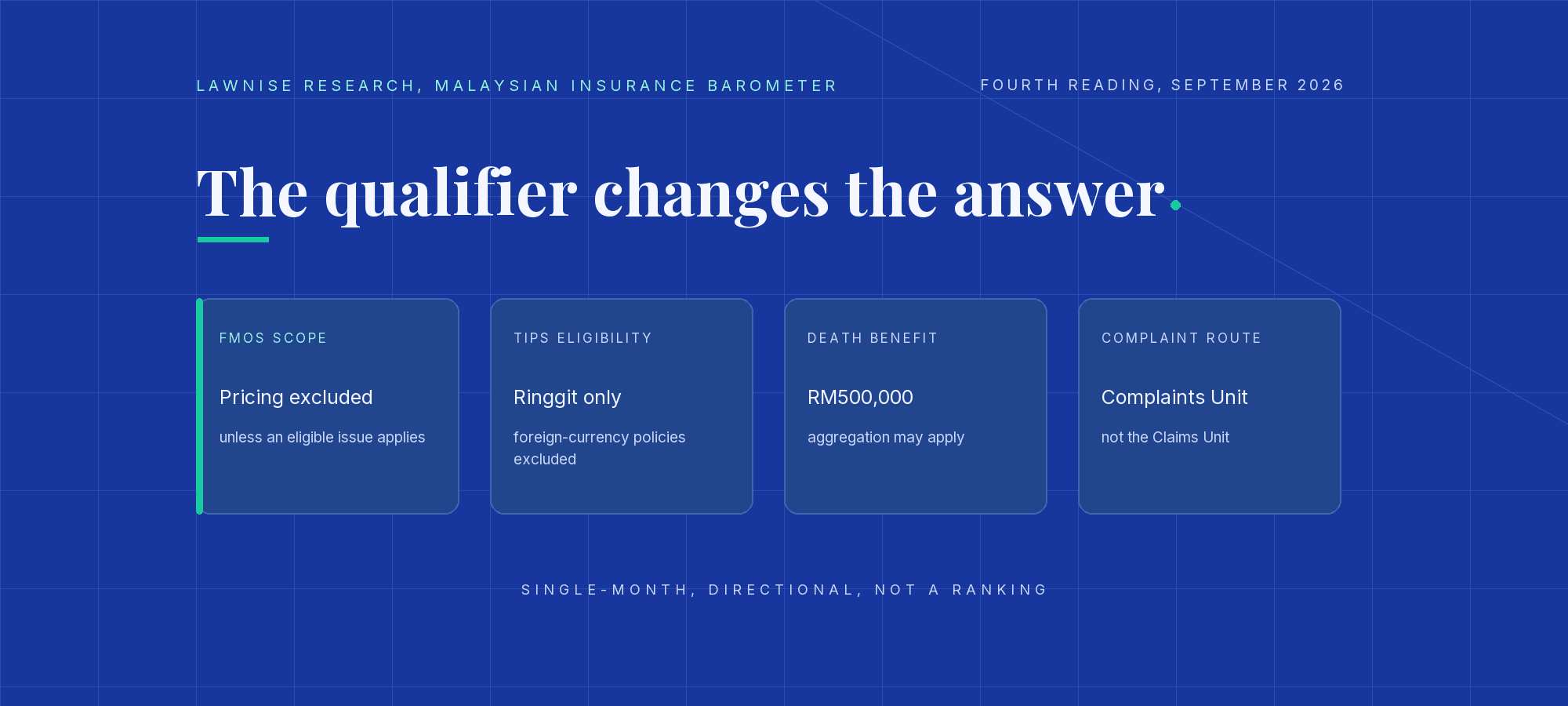
An answer can use the right institution, the right scheme and even the right headline figure, then give the reader the wrong rule.
That happened in the September examples below. One answer placed a complaint about high premiums within the ombudsman's scope even though ordinary pricing decisions are excluded. Another described a foreign-currency policy as protected by PIDM despite the Ringgit-denomination condition. Elsewhere, a shared RM500,000 boundary became a per-policy limit, and emailing a Claims Unit was treated as completing a step that Bank Negara Malaysia directs to the designated Complaints Unit.
Other reviewed answers handled these subjects correctly. The findings here are individual cases, not a rate, ranking or statement about any AI provider's performance.
How we checked September's Malaysian insurance answers
We put practical insurance questions to ChatGPT, Copilot, Gemini, Google AI Mode, Google AI Overview and Perplexity. The questions covered statutory protection, complaint routes and the service information people may need before acting.
September's Perplexity capture was materially incomplete because of an authentication failure. We therefore exclude it from comparisons and coverage claims. None of the findings in this article depends on a Perplexity answer.
For each featured case, we read the full response and checked the disputed statement against the current official source. The reviewed examples were selected for examination rather than drawn as a random or complete sample, so they do not establish how often an error occurs. Private insurers remain unnamed. Public bodies and schemes are named where their own published rules provide the reference point.
The same protection figure can govern different things
Insurance guidance often puts a short figure beside a qualified rule. The qualification decides what the figure means.
- RM500,000 is the TIPS limit for death and related benefits in the relevant category. It is not automatically a fresh limit for every policy held by the same owner for the same insured life and event.
- Ringgit Malaysia denomination is an eligibility condition for TIPS protection. A foreign-currency policy does not become protected through conversion into Ringgit.
- The Complaints Unit is the formal internal destination identified by Bank Negara Malaysia. A Claims Unit is not interchangeable with it.
FMOS scope works the same way. An eligible complaint about non-disclosure or mis-selling may involve premiums, but a complaint that simply challenges general or product pricing remains a commercial decision outside FMOS's ordinary scope.
Four answers that changed protection or redress
A pricing complaint was sent to a forum that excludes ordinary pricing decisions
A policyholder asked whether they could file a dispute with FMOS because their premiums felt too high. The answer said yes, after first complaining to the insurer, and added that FMOS could examine whether the pricing adjustment was justified.
FMOS lists general and product pricing, fees and charges among excluded commercial decisions. There is an important exception: a separately eligible allegation involving non-disclosure, misrepresentation or mis-selling may still be considered. But the question described no such allegation. It asked only whether the premium was too high.
That distinction matters before a consumer spends time preparing a dispute for a body whose published scope excludes the issue as presented.
A US-dollar policy was described as protected under TIPS
Another answer said a USD-denominated life policy would remain protected by PIDM and that its benefits would be converted into Ringgit for protection.
PIDM's TIPS guidance says the opposite. To qualify, a policy must be issued in Malaysia by an insurer member and denominated in Ringgit Malaysia. The same guidance expressly lists benefits under foreign-currency policies among those not protected.
The error is not about the exchange rate used for a protected benefit. It creates protection where the published eligibility rule says there is none.
One RM500,000 limit became a limit for every policy
A question asked for the maximum PIDM protection for death benefits. The answer gave the correct RM500,000 headline, then stated that it applied "per policy." For multiple policies on the same life with the same insurer and policy owner, that wording implies a separate limit where PIDM's aggregation rule applies.
PIDM applies an aggregation rule when benefits relate to the same insurer member, risk event, life insured and policy owner. Its worked example combines a whole-life policy and an endowment policy owned by the same person for the same insured life and death event. Although the two policies total RM600,000, the protected amount is capped at RM500,000.
The headline number was familiar. The unit it attached to was wrong, leaving a policyholder with multiple policies able to overestimate the statutory protection available.
A Claims Unit was treated as the Complaints Unit
A consumer said they had emailed their insurer's Claims Unit and asked whether they could now escalate directly to Bank Negara Malaysia. The answer said yes and treated that email as completion of the required internal step.
Bank Negara Malaysia states that a Business Unit or Claims Unit is not the Complaints Unit. Its published process requires the complaint to be lodged with the financial service provider's designated Complaints Unit before BNM will accept it.
The issue is procedural rather than semantic. A consumer may believe the required complaint process has begun when the message went to a different internal function.
Accurate handling was also present. Reviewed answers correctly explained the 14-day BNMLINK threshold, separate treatment of individual and employer group-policy benefits, healthcare protection at 100% of the amount payable, and the restriction on standalone “Guaranteed by PIDM” advertising. Other answers correctly distinguished the Claims Unit from the Complaints Unit and gave current claim-submission channels. Flags that did not hold against the source were cleared.
Why these errors matter to insurers
The official guidance was available and specific. The difficulty sits between that record and the person trying to use it.
A consumer might prepare a dispute that the ombudsman's published scope excludes. Someone holding a foreign-currency policy could assume a statutory safety net that is not there, while a policyholder with several policies on the same life may add limits that should be aggregated. A complaint sent to a Claims Unit may also fail to complete the designated complaint step the consumer believes they have taken.
Insurers cannot edit answers produced by public AI systems. They can still examine material answers about their market, compare them with current sources and keep evidence of what people may encounter before contacting the institution.
This is separate from correcting an insurer's own website. The source can be current while the answer circulating about it is not.
How to check public AI answers about insurance
The useful unit of review is an answer that could change what someone does next.
- Start with questions people ask before relying on protection, filing a complaint or escalating a dispute.
- Read the complete answer. A correct opening can be undone by a later table or qualification.
- Check each material statement against the current regulator, scheme or institution source.
- Distinguish a wrong rule from an incomplete answer, a defensible qualification and a harmless wording difference.
- Keep private institutions anonymous unless a separate approval permits naming them.
- Preserve the prompt, answer, source and retrieval date so the review remains auditable.
This does not claim continuous monitoring or complete coverage. It is a disciplined way to examine selected answers that may influence a consumer's decision.
Reading history
This page is refreshed in place at the same address. Open a previous reading to see the findings checked in that month, the published boundaries used to assess them and the limits of that reading. Each month stands on its own. We do not infer a trend or compare how often errors occurred across readings.
First reading · June 2026The findings concerned how TIPS limits aggregate, the death-benefit protection figure and the effective date of PIDM's disclosure guidance.
Protection across multiple policies
An answer described the RM500,000 TIPS limit as applying independently to each policy. PIDM aggregates protected benefits when they concern the same insurer member, risk event, life insured and policy owner.
Official boundary: Multiple policies do not automatically create a fresh RM500,000 limit for each policy. PIDM's aggregation conditions determine the protected total.
Source: PIDM, Takaful and Insurance Benefits Protection System FAQs. Accessed 24 June 2026.
Death-benefit protection figure
An answer used the RM250,000 deposit-insurance figure for life-insurance protection. PIDM's TIPS table sets RM500,000 as the limit for death and related benefits in the relevant category.
Official boundary: RM250,000 is the Deposit Insurance System headline limit. It is not the TIPS death-benefit figure.
Source: PIDM, Takaful and Insurance Benefits Protection System coverage and FAQs. Accessed 24 June 2026.
Effective date of the TIPS information guidelines
An answer dated the Guidelines on Provision of Information on Takaful and Insurance Benefits Protection to 1 July 2014. PIDM's published guideline was issued on 27 July 2022 and took effect on 1 June 2024.
Official boundary: The finding concerns the effective date of the disclosure guideline, not the start date of TIPS itself.
Checked and cleared: A reviewed answer's 60-day period was checked against the FMOS escalation rule and was not treated as a timing error. The review withdrew an earlier comparison with the separate BNMLINK route.
Methodology: v1.1
Limit: This was a single-month, diversity-selected reading. These examples do not establish an error rate, tested-set distribution, provider comparison or trend.
Second reading · July 2026The findings concerned a disability-benefit age boundary, claim acknowledgement and a complaint-response timetable.
Disability-benefit age boundary
An answer said a total and permanent disability benefit ended at age 60. The policy contract provided the benefit before the insured's 64th birthday, with no benefit payable on or after that birthday.
Official boundary: The contract's age boundary was the insured's 64th birthday, not age 60.
Source: Policy contract of a Malaysian insurer, institution withheld. Accessed 1 July 2026.
Claim acknowledgement
A reviewed answer did not give the insurer's published acknowledgement standard and instead described a different processing period. The insurer's client charter stated that a claim notification would be acknowledged within 7 working days.
Official boundary: Acknowledging receipt is a different stage from processing or deciding a claim.
Source: Client charter of a Malaysian insurer, institution withheld. Accessed 1 July 2026.
Complaint-response timetable
An answer restated working-day complaint periods as calendar days and omitted the published extension window for a matter requiring more time.
Official boundary: The source expressed the relevant periods in working days and included a separate extension for complex matters.
Source: Complaint-handling material of a Malaysian insurer, institution withheld. Accessed 1 July 2026.
Checked and cleared: A reviewed answer correctly identified the current financial ombudsman and another correctly described a published policy free-look period. Those examples were not treated as findings.
Methodology: v1.1
Limit: This was a single-month, diversity-selected reading. These examples do not establish an error rate, tested-set distribution, provider comparison or trend.
Third reading · August 2026The findings concerned complaint escalation, the internal complaint route and two TIPS benefit boundaries.
BNMLINK referral period
An answer told a consumer to wait 60 calendar days before referring an unanswered complaint to BNMLINK. Bank Negara Malaysia's published process permits referral to BNMLINK after no response for 14 days.
Official boundary: The 14-day period concerns BNMLINK referral after no response. It is distinct from FMOS's separate 60-day no-response route.
Source: Bank Negara Malaysia, Lodge a Complaint. Accessed 11 August 2026.
Claims Unit versus Complaints Unit
An answer treated contact with an insurer's Claims Unit as the required internal complaint step. Bank Negara Malaysia states that the Business Unit or Claims Unit is not the designated Complaints Unit.
Official boundary: A complaint must first be referred to the financial service provider's designated Complaints Unit before BNM will accept it.
Source: Bank Negara Malaysia, Lodge a Complaint. Accessed 11 August 2026.
Healthcare protection
An answer described healthcare benefits as capped at RM500,000. PIDM's TIPS table lists healthcare at 100% of the amount payable.
Official boundary: Healthcare has its own row and limit. The RM500,000 figure applies to other listed benefit categories.
Source: PIDM, Takaful and Insurance Benefits Protection System FAQs. Accessed 10 August 2026.
Death benefit from the unit portion
An answer said the portion of a death payout arising from investment units was not protected. PIDM states that misfortune benefits, including death benefits, payable from the unit portion are protected under TIPS.
Official boundary: Maturity, surrender and income benefits from the unit portion are excluded. A death benefit is treated differently.
Source: PIDM, Takaful and Insurance Benefits Protection System FAQs. Accessed 10 August 2026.
Checked and cleared: Reviewed answers correctly handled an ombudsman scope question and a policy free-look period. One answer was also current on the ombudsman's FMOS name. Those examples were not treated as findings.
Methodology: v1.1
Limit: This was a single-month, diversity-selected reading. These examples do not establish an error rate, tested-set distribution, provider comparison or trend.
Read on
Lawnise maintains this barometer as an evidence-led view of what public AI may tell people about high-intent insurance questions. To examine selected answers circulating about your institution or market, scope a private AI answer baseline.
How to cite this
- Short form
- Lawnise Research & Editorial team. (2026). The State of AI Answer Accuracy in Malaysian Insurance, A Preliminary Barometer. Lawnise. https://www.lawnise.com/research/ai-answer-accuracy-malaysia-insurance
- Long form (APA)
- Lawnise Research & Editorial team. (2026, June 15). The State of AI Answer Accuracy in Malaysian Insurance, A Preliminary Barometer (Methodology v1.1). Lawnise. https://www.lawnise.com/research/ai-answer-accuracy-malaysia-insurance
- BibTeX
@misc{lawnise2026aiansweraccuracymalaysiainsurance,
  author = {Lawnise Research and Editorial team},
  title = {The State of AI Answer Accuracy in Malaysian Insurance, A Preliminary Barometer},
  year = {2026},
  publisher = {Lawnise},
  url = {https://www.lawnise.com/research/ai-answer-accuracy-malaysia-insurance}
}
References
- [1]Lawnise Methodology (v1.1). Each featured finding was checked against the full AI response and pinned official-source evidence. Examples were selected for review rather than drawn as a random or complete sample. Findings are reported without provider ranking, tested-set rates or adverse institution naming. https://www.lawnise.com/trust-index/methodology/v1#main
- [2]Financial Markets Ombudsman Service, What FMOS Can and Cannot Handle. FMOS lists general and product pricing, fees and charges among excluded commercial decisions, except where an eligible allegation concerns non-disclosure, misrepresentation or mis-selling. https://www.fmos.org.my/en/our-scope/(accessed 2026-09-04)
- [3]Perbadanan Insurans Deposit Malaysia, Takaful and Insurance Benefits Protection System FAQs. PIDM TIPS eligibility requires Ringgit Malaysia denomination; foreign-currency policies are excluded. The page also states the aggregation conditions used in the death-benefit finding. https://www.pidm.gov.my/general/faqs/takaful-insurance-benefits-protection-system(accessed 2026-09-04)
- [4]Perbadanan Insurans Deposit Malaysia, Takaful and Insurance Benefits Protection System Handbook. The PIDM worked aggregation example combines two policies owned by the same person for the same insured life and event and caps the protected amount at RM500,000. https://www.pidm.gov.my/getContentAsset/8b646261-6015-4d79-bfcb-a6f4b38633d6/188ea75b-0100-4438-8f97-d79a01d9e0cd/6c1cbd6b-0209-41c3-a500-d244c5021948.pdf?language=en(accessed 2026-09-04)
- [5]Bank Negara Malaysia, Lodge a Complaint. Bank Negara Malaysia states that the Business Unit or Claims Unit is not the Complaints Unit and that complaints must first be referred to the designated Complaints Unit. https://www.bnm.gov.my/contact-us/lodge-complaint(accessed 2026-08-11)