Market + AI Trend Intelligence
The State of AI Answer Accuracy in Malaysian Banking, A Preliminary Barometer
Lawnise checks public AI answers about Malaysian banking. October findings concern deposit protection, complaint escalation and debt restructuring.
Lawnise Research & Editorial team
Institutional byline · published by Lawnise
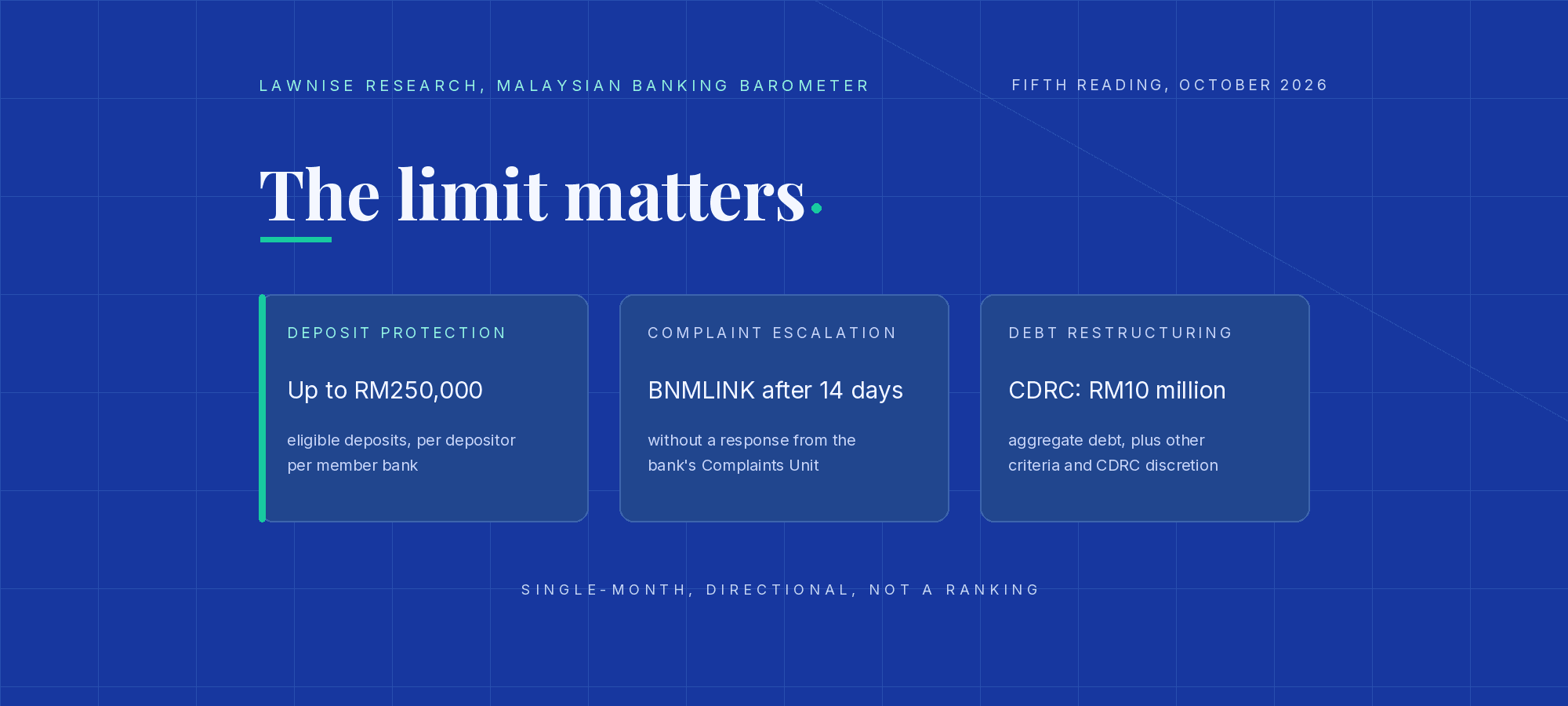
A question about savings in a Malaysian bank needs Malaysia's deposit-protection limit. One reviewed answer never supplied it.
This October reading checks that omission alongside two different errors: a complaint-escalation wait applied to the wrong route, and a debt threshold that could discourage a business from seeking help.
As of October 2026
How we checked October's Malaysian banking answers
The October capture included ChatGPT, Copilot, Gemini, Google AI Mode, Google AI Overview and Perplexity. Copilot and Perplexity coverage was materially incomplete. We make no comparison of providers or claim about changes in their performance.
We read complete answers, including successful responses that automated checks had not flagged. For each featured finding, we checked the actual question and compared the disputed statement with retained official-source evidence. An automated label was a starting point for review, not the verdict.
These selected examples do not represent all questions people ask or establish how often an error occurs. Private institutions and provider attribution are withheld from individual findings. Public bodies are named where their published guidance supplies the comparison.
Our research methodology explains the wider approach. Full responses and evidence records are retained internally for audit and correction or right-to-reply review.
The limits and conditions behind the findings
A protection limit needs its coverage conditions. A complaint deadline belongs to a particular route. A debt threshold is only part of the test for admission to a restructuring process.
Keeping those conditions attached is more useful than giving a confident number on its own. It also avoids replacing one oversimplification with another: RM250,000 does not cover every financial product, and meeting CDRC's numerical criterion does not guarantee admission.
Where the reviewed answers changed the practical advice
Malaysia's deposit-protection limit was missing
The question was explicit: if a bank in Malaysia goes bankrupt, what is the maximum amount of savings protected?
The answer opened with India's deposit-insurance scheme and later described protection in the United States and United Kingdom. It never supplied the Malaysian limit. Whatever usefulness those descriptions might have elsewhere, they did not answer the question asked.
PIDM's Deposit Insurance System FAQ states that eligible deposits are protected up to RM250,000 per depositor per member bank, including principal and interest or return. The limit applies separately to Islamic and conventional deposits. Eligibility remains important; this is not protection for every investment sold by a bank.
The finding is the missing Malaysian coverage answer, not a comparison of foreign schemes. A depositor relying on the response would still need to find the applicable limit before assessing their own position.
FMOS's waiting condition was applied to BNMLINK too
Asked where to escalate an unresolved bank complaint, an answer first told the customer to obtain a final decision or wait at least 60 days. It then listed external routes including FMOS and BNMLINK under that prerequisite.
The 60-day no-response route belongs to FMOS's published complaint process. It is not a blanket waiting period for every external body.
BNM's complaint page requires the complaint to be referred to the provider's Complaints Unit first. It then permits referral to BNMLINK after 14 days without a response from that unit. The answer's general prerequisite could leave a customer waiting longer than this published route requires.
This does not mean BNMLINK and FMOS are interchangeable, that every dispute is eligible, or that referral guarantees compensation. The error was treating their different processes as one. The 14-day wording should not be recast as a universal period from any first contact with a bank.
CDRC's debt criterion was overstated
A company asked whether there was a way to work out a resolution with creditors without going to court. The answer correctly identified the Corporate Debt Restructuring Committee, but said it generally required aggregate debt of RM30 million or more.
The CDRC Participants' Code of Conduct, revised on 4 August 2025, sets a different numerical criterion. Clause 5.1(a) specifies aggregate indebtedness of at least RM10 million, involving at least two participating institutions. Other admission criteria also apply, and clause 5.3 preserves CDRC's discretion to accept or reject applications.
The finding concerns the overstated threshold, not a promise that every business with RM10 million of debt qualifies. A company with debt between RM10 million and RM30 million could be discouraged from checking a route that the answer had named correctly.
Correct handling was also present. A reviewed escalation answer kept the routes separate: it identified FMOS's 60-day no-response condition and BNM's 14-day no-response route after approaching the Complaints Unit. That specific distinction was supported by the sources. It is not an endorsement of every statement in that answer or an estimate of overall accuracy.
Why these errors matter to banks and their customers
The deposit answer left the central question unanswered. In the other cases, the right body was named but a condition was misstated. Recognising a public institution is therefore not enough to judge whether an explanation can be relied on.
An extended waiting period may delay a complaint. An overstated threshold may make a business dismiss a possible route before reading the Code. We did not observe those outcomes; they explain why the disputed statements were material enough to examine.
For a bank's customer-service or risk team, a useful response is to have the applicable source and its conditions ready. Public AI answers sit outside the bank's controlled publishing perimeter. The bank did not write them, but customers may consult them before checking official guidance or contacting the institution.
How to check public AI answers about banking
Start with the question the customer actually asked. Read the full response before deciding whether an apparent error survives its qualifications.
For numerical claims, check what the number measures and who or what it covers. For process claims, identify the exact route and prerequisite. Retain the dated source, and distinguish a clear conflict from an outdated reference, a reasonable estimate or unresolved source timing.
This is a review of selected answers, not continuous monitoring or an assurance that all answers have been checked. It provides a documented basis for correcting a material misunderstanding without treating every imperfect sentence as a finding.
Reading history
This page is refreshed in place at the same address. Open a previous reading to see the findings checked in that month, the published boundaries used to assess them and the limits of that reading. Each month stands on its own. We do not infer a trend or compare how often errors occurred across readings.
First reading · June 2026The findings concerned published processing and complaint-decision periods that were restated as longer.
Credit-card application processing
Reviewed answers restated a published commitment of processing a complete card application within 3 working days as periods ranging from 5 working days to several weeks.
Official boundary: The published customer-service commitment was within 3 working days for a complete application. It was a service commitment, not evidence of every applicant's actual elapsed time.
Source: Customer service charters of Malaysian banks, institutions withheld. Accessed 23 June 2026.
Mortgage application processing
An answer described a mortgage decision as taking about 30 days where the checked charter stated a 5-working-day processing commitment for a complete individual application.
Official boundary: The 5-working-day commitment applied to a complete individual mortgage application. It did not guarantee the total time for every application or incomplete submission.
Source: Customer service charter of a Malaysian bank, institution withheld. Accessed 23 June 2026.
Complaint-decision period
An answer gave 20 working days for a complaint decision. The checked Malaysian charter stated that a decision would be communicated no later than 14 calendar days, while the answer had imported a different-market period.
Official boundary: The finding concerned the published decision-communication period in the checked Malaysian charter, not every stage of complaint handling.
Source: Customer service charter of a Malaysian bank, institution withheld. Accessed 23 June 2026.
Checked and cleared: On the card-processing question, a reviewed answer gave the published 3-working-day commitment. Other reviewed mortgage answers stayed close to the published 5-working-day commitment. These examples were not treated as findings.
Methodology: v1.1
Limit: This was a single-month, diversity-selected reading. These examples do not establish an error rate, tested-set distribution, provider comparison or trend.
Second reading · July 2026The findings concerned deposit protection, regulator scope, financing terms and correction of a credit record.
Joint-account deposit protection
An answer said a joint account was not separately protected. PIDM states that eligible deposits held in a joint account enjoy deposit-insurance protection separately from deposits held in individual accounts.
Official boundary: Separate joint-account protection remains subject to PIDM eligibility rules and the applicable per-depositor-per-member-bank limit.
Source: PIDM, Deposit Insurance System FAQs. Accessed 1 July 2026.
Pawn-broker complaint route
An answer directed a complaint about a licensed pawn broker to Bank Negara Malaysia. BNM's published complaint page states that pawn brokers are not regulated by BNM.
Official boundary: The source establishes that pawn brokers are outside BNM's regulatory remit. It does not establish that BNM cannot receive or redirect correspondence.
Source: Bank Negara Malaysia, Lodge a Complaint. Accessed 1 July 2026.
Investment-financing terms
An answer presented a tiered rate structure that did not match the checked product publication. The publication stated financing up to RM200,000, a rate from about 4.45% a year and monthly repayment from RM47.
Official boundary: The finding concerned the product terms available in the dated publication. It did not establish availability or pricing for every applicant.
Source: Official investment-financing product page of a Malaysian bank, institution withheld. Accessed 1 July 2026.
Correcting a CCRIS record
An answer said only BNM could correct an inaccurate CCRIS record and named a form that was not part of the published process. BNM directs the consumer to the reporting financial institution, which verifies and resubmits corrected information.
Official boundary: BNM maintains CCRIS, but correction of submitted data begins with the financial institution that reported it.
Checked and cleared: A reviewed answer correctly stated that an eligible joint account receives separate deposit-insurance protection. That answer was not treated as a finding.
Methodology: v1.1
Limit: This was a single-month, diversity-selected reading. These examples do not establish an error rate, tested-set distribution, provider comparison or trend.
Correction: The earlier July article also compared general branch-wait estimates with a service-charter target. That item is omitted here because a charter target does not establish the actual queue a customer should expect. Corrected 6 September 2026.
Third reading · August 2026The findings concerned wrong-country institutions and processes, regulator scope and the national credit record.
Malaysia financial ombudsman answered as UK
An answer described the United Kingdom's ombudsman and a UK Act when asked which regulators established Malaysia's Financial Markets Ombudsman Service.
Official boundary: Malaysia's FMOS was established on 1 January 2025 through the consolidation of two predecessor bodies by Bank Negara Malaysia and the Securities Commission Malaysia.
Source: Financial Markets Ombudsman Service, FAQ. Accessed 21 August 2026.
Deposit reimbursement answered with another country process
An answer directed a Malaysian depositor to the United States deposit insurer and a claim-form process. PIDM states that depositors do not need to file a claim after a member-bank failure; PIDM announces how they can access deposits or receive reimbursement.
Official boundary: The finding concerns Malaysia's no-claim process. It does not describe the process used in another jurisdiction.
Source: PIDM, Deposit Insurance System FAQs. Accessed 21 August 2026.
Pawn-broker complaint route
An answer directed a pawn-broker complaint to BNM. BNM's published page states that pawn brokers are not regulated by BNM.
Official boundary: The source establishes that pawn brokers are outside BNM's regulatory remit. It does not establish that BNM cannot receive or redirect correspondence.
Source: Bank Negara Malaysia, Lodge a Complaint. Accessed 11 August 2026.
CCRIS described as a long-term blacklist
An answer described a missed payment as remaining on a CCRIS blacklist for 5 to 7 years. Another attributed CCRIS to legislation governing private credit bureaus.
Official boundary: BNM states that CCRIS is not a blacklist and that the report covers the past 12 months. CCRIS is governed by the central-bank and financial-services statutes identified by BNM; private credit bureaus are separately governed under the Credit Reporting Agencies Act 2010.
Source: Bank Negara Malaysia, CCRIS. Accessed 21 August 2026.
Checked and cleared: Reviewed answers correctly described PIDM's treatment of foreign-currency deposits and the free online route for obtaining a personal credit report. Those examples were not treated as findings.
Methodology: v1.1
Limit: This was a single-month, diversity-selected reading. These examples do not establish an error rate, tested-set distribution, provider comparison or trend.
Fourth reading · September 2026The corrected September reading concerns a statement-objection period and a product-specific withdrawal rule. The financing-rate finding originally published in that reading was withdrawn on 7 October 2026.
Statement-objection period
An answer gave up to 60 days to dispute a transaction shown on an account statement. The checked general account terms set a default objection period of 14 days after receiving a statement, or from the online statement date, unless another period is specified in the statement or notice.
Official boundary: The published default and its qualifications belong together. This is not a finding about a card-specific chargeback deadline or the loss of every right after 14 days.
Source: A Malaysian bank, general terms and conditions of accounts, institution withheld. Accessed 5 September 2026.
Online fixed-deposit partial withdrawal
Two answers presented partial withdrawal before maturity as an available option for the checked online fixed deposit. The product FAQ answered that question with "No."
Official boundary: This is specific to the online product reviewed. It does not establish that every Malaysian fixed deposit excludes partial withdrawal or that full early withdrawal is impossible.
Source: A Malaysian bank, online fixed-deposit FAQ, institution withheld. Accessed 5 September 2026.
Checked and cleared: The September reading recorded accurate handling of a bank's published mortgage-processing standard, offered fixed-deposit tenures, the effect of premature withdrawal on interest for another deposit product, and qualifying conditions for a fast home-financing decision. These were specific recorded observations, not an estimate of overall accuracy.
Methodology: v1.1
Limit: This was a single-month, diversity-selected reading. These examples do not establish an error rate, tested-set distribution, provider comparison or trend.
Correction: We previously described quoted financing rates as below a published minimum of 4.45%. An official table lists lower conditional rates for a promotion period covering this reading, and our evidence does not establish that the quoted rates were wrong. We have withdrawn that finding. The statement-objection and online fixed-deposit findings remain. Corrected 7 October 2026.
Read on
Lawnise maintains this barometer as an evidence-led view of selected public AI answers about Malaysian banking. To examine material answers circulating about your institution or market, scope a private AI answer baseline.
How to cite this
- Short form
- Lawnise Research & Editorial team. (2026). The State of AI Answer Accuracy in Malaysian Banking, A Preliminary Barometer. Lawnise. https://www.lawnise.com/research/ai-answer-accuracy-malaysia-banks
- Long form (APA)
- Lawnise Research & Editorial team. (2026, June 12). The State of AI Answer Accuracy in Malaysian Banking, A Preliminary Barometer (Methodology v1.1). Lawnise. https://www.lawnise.com/research/ai-answer-accuracy-malaysia-banks
- BibTeX
@misc{lawnise2026aiansweraccuracymalaysiabanks,
  author = {Lawnise Research and Editorial team},
  title = {The State of AI Answer Accuracy in Malaysian Banking, A Preliminary Barometer},
  year = {2026},
  publisher = {Lawnise},
  url = {https://www.lawnise.com/research/ai-answer-accuracy-malaysia-banks}
}
References
- [1]Lawnise Methodology (v1.1). Each featured finding was checked against the full answer and retained official-source evidence. Selected examples do not establish prevalence. https://www.lawnise.com/trust-index/methodology/v1#main
- [2]PIDM, Deposit Insurance System FAQ. protection-limit and eligibility sections. Official HTML captured 7 October 2026; wording rechecked 8 October 2026. https://www.pidm.gov.my/general/faqs/deposit-insurance-system(accessed 2026-10-08)
- [3]Bank Negara Malaysia, Lodge a Complaint. Steps 1 and 3. Official HTML captured 7 October 2026; wording rechecked 8 October 2026. An earlier retained August capture carries the same 14-day no-response referral wording. https://www.bnm.gov.my/contact-us/lodge-complaint(accessed 2026-10-08)
- [4]Financial Markets Ombudsman Service, Filing a Complaint with FMOS. 60-day no-response route. Official HTML captured 7 October 2026; wording rechecked 8 October 2026. https://www.fmos.org.my/en/filing-a-complaint-with-fmos-what-to-expect-and-what-you-need-to-know/(accessed 2026-10-08)
- [5]Corporate Debt Restructuring Committee, Participants' Code of Conduct, revision 4 August 2025. clauses 5.1(a) and 5.3. Original PDF captured 7 October 2026; relevant clauses rechecked 8 October 2026. https://www.cdrc.my/pdf/CDRC_Code_of_Conduct_August_2025.pdf(accessed 2026-10-08)