Market + AI Trend Intelligence
The State of AI Answer Accuracy in Singapore Banking, A Preliminary Barometer
Lawnise checks public AI answers against Singapore banking rules. October examples concern card liability, mortgage tenure and interest-only purchase loans.
Lawnise Research & Editorial team
Institutional byline · published by Lawnise
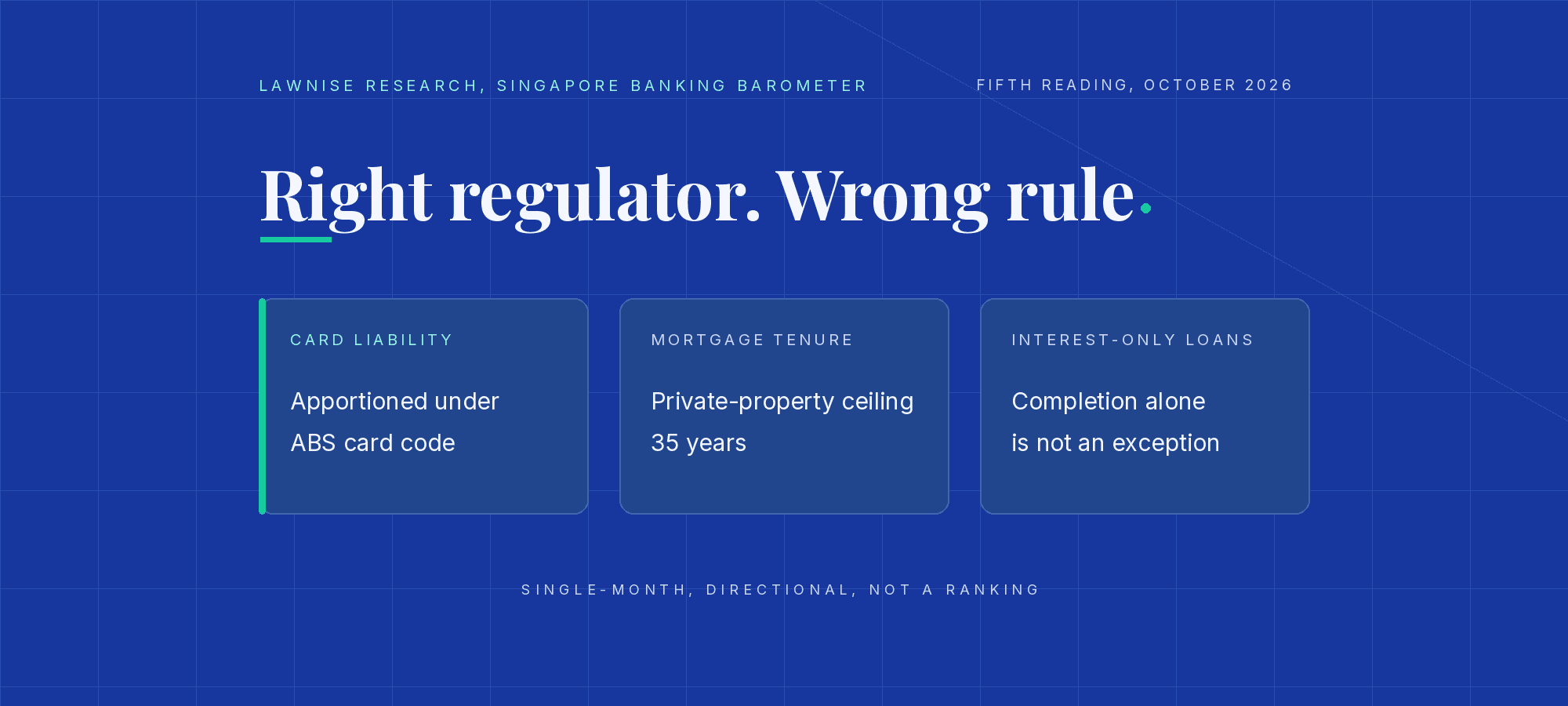
An answer can name the right regulator and still apply the wrong rule. This October reading examines AI answer accuracy in Singapore banking through selected answers about card liability and residential-property borrowing, checked against official source documents.
As of October 2026
How we checked October's Singapore banking answers
Lawnise's October capture covered questions about Singapore banking on ChatGPT, Copilot, Gemini, Google AI Mode, Google AI Overview and Perplexity. Copilot and Perplexity coverage was materially incomplete. We make no provider comparison, population error-rate estimate or month-over-month trend claim from this reading.
For each featured example, we read the complete captured answer, checked the question it was answering and compared the disputed claim with official source documents retained for review. We did not treat an automated flag or a shortened excerpt as proof of an error.
The featured answers were selected for examination, not drawn as a representative sample of all answers. This article establishes what those answers said and how their claims differ from the sources. It does not establish prevalence.
Our research methodology explains the wider framework. AI-provider attribution and identifying citation labels are withheld from individual examples; the full responses and evidence records are retained internally for audit and correction or right-to-reply review.
Three answers that changed the applicable rule
Card liability was assigned to the wrong framework
The question asked whether the E-Payments User Protection Guidelines cover unauthorised transactions on a Singapore-issued credit card. The answer said yes, then described liability allocation as part of those guidelines.
Footnote 3 of the guidelines distinguishes the applicable framework. Their liability-apportionment provisions do not apply to transactions on Singapore-issued credit, charge and debit cards. The footnote says those cardholders already benefit from liability apportionment under the ABS Code of Practice for Banks - Credit Cards, issued by the Association of Banks in Singapore.
This does not mean cardholders have no protection, or that every part of the guidelines excludes cards. The error was applying the guidelines' liability allocation to a transaction for which the source identifies a different framework. A customer relying on that answer could approach a dispute with the wrong expectations about how losses are assessed.
Thirty years was presented as the private-property maximum
Asked how maximum loan tenure differs between an HDB flat and a private residential property, another answer presented private-property bank financing as up to 30 years. Its table used the heading "Maximum typical tenure", and its explanation said both property types could "generally" go up to 30 years.
Those qualifications matter: the answer did not expressly claim to quote a legal ceiling. Nevertheless, it answered a maximum-tenure question without explaining the regulatory limit. MAS Notice 632 sets a 35-year ceiling for the bank facilities covered by paragraph 21, subject to the HDB-specific rule in paragraph 22.
Thirty years is not an irrelevant number. Longer private-property tenures attract lower loan-to-value limits under the Notice. A bank's lending policy and a borrower's circumstances can also constrain the actual offer. The finding is that the answer presented 30 years as the maximum without explaining the difference between tenure eligibility and borrowing limits.
Completion status became an interest-only exception
A third question asked whether a bank could offer an interest-only loan or an interest absorption scheme for a residential-property purchase. The answer correctly described the prohibition on interest absorption schemes, but suggested that completed private investment properties could receive interest-only periods case by case.
Paragraph 3 of MAS Notice 632 prohibits interest-only terms for bank residential-property purchase facilities. Completion status or investment use alone does not establish a general exception.
The Notice contains specific exclusions and transitional provisions. Our finding is not that every possible facility is prohibited. It is narrower: the answer gave completion and investment status as a route to interest-only purchase financing without identifying a relevant exclusion. The statement concerns banks and ordinary purchase financing, not every non-bank lender or every form of property-backed credit.
For a buyer planning cash flow around an initial interest-only period, that missing distinction could materially change the financing assumptions.
Correct handling was also present. Reviewed answers correctly distinguished FIDReC's uncapped eligible mediation from its S$150,000 adjudication limit and described CPFIS and CPFRS monies as a combined deposit-insurance bucket separate from ordinary deposits. These are checks of specific propositions, not endorsements of every statement in those answers or an estimate of overall accuracy.
Why these distinctions matter
These examples concern the boundary of a rule: which liability framework applies, whether a figure is a ceiling or a lending threshold, and what actually qualifies for an exception.
A fluent explanation can blur those boundaries without looking obviously implausible. For risk, compliance and customer-service teams, the useful question is not simply whether an answer sounds informed. It is whether the answer preserves the conditions a customer needs before acting.
The practical response is to review complete answers, retain the governing source and separate material errors from qualifications, source uncertainty and prompt ambiguity. Institutions can use that evidence to prepare frontline explanations and improve information they control. This does not make them the authors of the third-party AI answers.
Reading history
This page is refreshed in place at the same address. Open a previous reading to see the findings checked in that month, the published boundaries used to assess them and the limits of that reading. Each month stands on its own. We do not infer a trend or compare how often errors occurred across readings.
First reading · June 2026Borrowing costs and a complaint acknowledgement period were stated differently from the institutions' published terms.
Cash-advance interest
An answer quoted the cash-advance interest rate as low as 26.9% per annum. The institution's published cash-advance rate was 28.5% per annum.
Official boundary: The relevant tariff listed cash-advance interest separately from the lower retail-purchase rate.
Source: Official tariff of a Singapore retail bank, institution withheld. Accessed 21 June 2026.
Card-purchase interest
An answer quoted a card-purchase interest rate of 15-18% per annum against the institution's published 27.9% per annum. The answer also disclosed that it did not have live access to current rates and directed the reader to the disclosure sheet.
Official boundary: The published card-purchase rate was 27.9% per annum. The answer's caveat did not correct the figure it supplied.
Source: Official credit-card disclosure sheet of a Singapore retail bank, institution withheld. Accessed 21 June 2026.
Complaint acknowledgement
An answer stated that a complaint would be acknowledged within five business days. The institution's published commitment was within two business days.
Official boundary: This was an acknowledgement period, not a resolution period.
Source: Official complaints page of a Singapore retail bank, institution withheld. Accessed 21 June 2026.
Methodology: v1.1
Limit: This was a single-month, diversity-selected reading. These examples do not establish an error rate, tested-set distribution, provider comparison or trend.
Second reading · July 2026Published limits, borrowing costs and a complaint outcome period were restated in ways that changed their practical meaning.
Lost-or-stolen card liability
An answer extended a card's S$100 lost-or-stolen liability cap to tokenised digital-wallet transactions. The card agreement expressly excluded those transactions from that capped-liability provision.
Official boundary: The S$100 cap applied subject to the card agreement's stated exclusions; it did not cover the tokenised wallet transactions in the question.
Source: Cardmember agreement of a Singapore card issuer, institution withheld. Accessed 1 July 2026.
Cash-advance cost
An answer stated a 6% cash-advance fee and an interest rate of about 28% per annum. The institution's published terms were an 8% fee and 28.5% per annum.
Official boundary: The fee and interest rate were separate published components of the cash-advance cost.
Source: Official tariff and disclosure materials of a Singapore retail bank, institution withheld. Accessed 1 July 2026.
Complaint outcome period
An answer supplied a 30-day or eight-week window. The institution's published commitment for the relevant complaint outcome was 20 business days.
Official boundary: The published figure concerned the outcome of the relevant investment or life-insurance product complaint, not a generic complaint-handling period.
Source: Official complaints material of a Singapore retail bank, institution withheld. Accessed 1 July 2026.
Checked and cleared: A reviewed deposit-insurance answer correctly stated the headline protection of up to S$100,000 per depositor per Scheme member. Its explanation of how some CPF and SRS monies aggregate added an unsupported detail, so we treated it as a correct headline with detail drift rather than a wholly incorrect answer.
Methodology: v1.1
Limit: This was a single-month, diversity-selected reading. These examples do not establish an error rate, tested-set distribution, provider comparison or trend.
Third reading · August 2026The findings concerned an overstatement of protection under an e-payments liability boundary, omitted protected-account eligibility conditions, and a scam-response framework reduced incorrectly to SMS-only.
First-S$1,000 liability boundary
An answer promised full reimbursement and zero liability for an unauthorised transaction. In the relevant case, the E-Payments User Protection Guidelines state that the account holder is not liable for the first S$1,000 of loss. That boundary does not itself guarantee reimbursement of the entire loss.
Official boundary: Paragraph 5.6 applies where the loss arises from the relevant third-party action or omission and does not arise from the account user's failure to comply with the duties in section 3.
Source: Monetary Authority of Singapore, E-Payments User Protection Guidelines. Accessed 11 August 2026.
Protected-account conditions
An answer treated a digital-payment provider as covered without stating the conditions that make an account a protected account. For a relevant payment-service provider, the guidelines require the defined account-issuance status and an account that stores specified e-money.
Official boundary: A different payment-service permission does not, by itself, establish that the provider and account meet the protected-account conditions.
Source: Monetary Authority of Singapore, E-Payments User Protection Guidelines. Accessed 11 August 2026.
Shared Responsibility Framework channel scope
An answer reduced the Shared Responsibility Framework to phishing delivered by SMS and placed a WhatsApp phishing loss outside it. The framework's definition covers digital messaging platforms including SMS, email, WhatsApp and social media. Its SMS-specific obligation concerns telecommunications operators; it is not the outer limit of the framework.
Official boundary: The framework-wide channel definition and the telecommunications operators' SMS duty are different provisions.
Checked and cleared: A reviewed answer set out the full claims workflow for an unauthorised transaction and identified the appropriate recourse body. Another gave the correct effective date for a framework while distinguishing a duty that commenced later.
Methodology: v1.1
Limit: This was a single-month, diversity-selected reading. These examples do not establish an error rate, tested-set distribution, provider comparison or trend.
Fourth reading · September 2026The findings concerned the first-S$1,000 e-payments liability boundary, two different housing-loan affordability tests and one combined CPF-linked deposit-insurance limit.
First-S$1,000 liability boundary
One answer promised zero liability and full reimbursement. Another said the account holder was liable for the first S$1,000. In the defined third-party/no-duty-breach scenario, the guidelines instead say the account holder is not liable for the first S$1,000 of loss.
Official boundary: Paragraph 5.6 does not itself promise reimbursement of the entire loss, nor does it put the first S$1,000 on the account holder.
MSR and TDSR
An answer gave both affordability tests a 55% threshold. The published guidance distinguishes a 30% Mortgage Servicing Ratio for the HDB flats and Executive Condominiums to which it applies from a 55% Total Debt Servicing Ratio.
Official boundary: MSR concerns the housing-loan instalment; TDSR concerns total monthly debt commitments. They are not interchangeable tests.
Combined CPF-linked deposit protection
An answer assigned separate S$100,000 limits to CPFIS and CPFRS monies. SDIC guidance says they are aggregated together and separately insured from ordinary deposits up to S$100,000.
Official boundary: Separation from ordinary deposits does not create one limit for CPFIS and another for CPFRS.
Source: Singapore Deposit Insurance Corporation, Calculation of Compensation. Accessed 3 September 2026.
Checked and cleared: The September reading also reported correct handling of the Shared Responsibility Framework waterfall, the EUPG investigation timeline, joint-account deposit-insurance treatment and FIDReC's mediation and adjudication limits. These are September's recorded review observations, not new October certifications.
Methodology: v1.1
Limit: This was a single-month, diversity-selected reading. These examples do not establish an error rate, tested-set distribution, provider comparison or trend. September's Perplexity capture was materially incomplete.
Read on
Compare this reading with our Singapore insurance barometer, or read how Lawnise verifies AI answers against published facts.
To examine the answers circulating about your own institution or market, scope a private AI answer baseline.
How to cite this
- Short form
- Lawnise Research & Editorial team. (2026). The State of AI Answer Accuracy in Singapore Banking, A Preliminary Barometer. Lawnise. https://www.lawnise.com/research/ai-answer-accuracy-singapore-banks
- Long form (APA)
- Lawnise Research & Editorial team. (2026, June 3). The State of AI Answer Accuracy in Singapore Banking, A Preliminary Barometer (Methodology v1.1). Lawnise. https://www.lawnise.com/research/ai-answer-accuracy-singapore-banks
- BibTeX
@misc{lawnise2026aiansweraccuracysingaporebanks,
  author = {Lawnise Research and Editorial team},
  title = {The State of AI Answer Accuracy in Singapore Banking, A Preliminary Barometer},
  year = {2026},
  publisher = {Lawnise},
  url = {https://www.lawnise.com/research/ai-answer-accuracy-singapore-banks}
}
References
- [1]Monetary Authority of Singapore, E-Payments User Protection Guidelines (effective 16 December 2024). Paragraph 1.2 and footnote 3 distinguish the credit-, charge- and debit-card liability framework. Source PDF checked and retained on 3 October 2026. https://www.mas.gov.sg/regulation/guidelines/e-payments-user-protection-guidelines(accessed 2026-10-03)
- [2]Monetary Authority of Singapore, Notice 632: Residential Property Loans (revised 21 August 2025). Paragraphs 3, 21 and 22; exclusions and lending-limit provisions checked for context. Official PDF retrieved and retained on 3 October 2026. https://www.mas.gov.sg/regulation/notices/notice-632(accessed 2026-10-03)
- [3]Lawnise Methodology (v1.1). This article reports selected verified examples, not an aggregate measurement. https://www.lawnise.com/trust-index/methodology/v1#main
- [4]FIDReC, About Us. Jurisdiction statement checked for the mediation/adjudication distinction in the positive note only. https://www.fidrec.com.sg/about/(accessed 2026-10-03)
- [5]Singapore Deposit Insurance Corporation, Calculation of Compensation. Checked for the combined CPFIS/CPFRS bucket in the positive note only. https://www.sdic.org.sg/di_calc/(accessed 2026-10-03)
- [6]MoneySense, Buying a property: How much can you afford?. Retained from the September source record for its historical MSR/TDSR finding; not a new October finding. https://www.moneysense.gov.sg/buying-a-property-how-much-can-you-afford/(accessed 2026-09-03)