Market + AI Trend Intelligence
The State of AI Answer Accuracy in Singapore's Insurance Sector, A Preliminary Barometer
Lawnise checks public AI answers about Singapore insurance. October examples examine protection-scheme membership and access to customer support.
Lawnise Research & Editorial team
Institutional byline · published by Lawnise
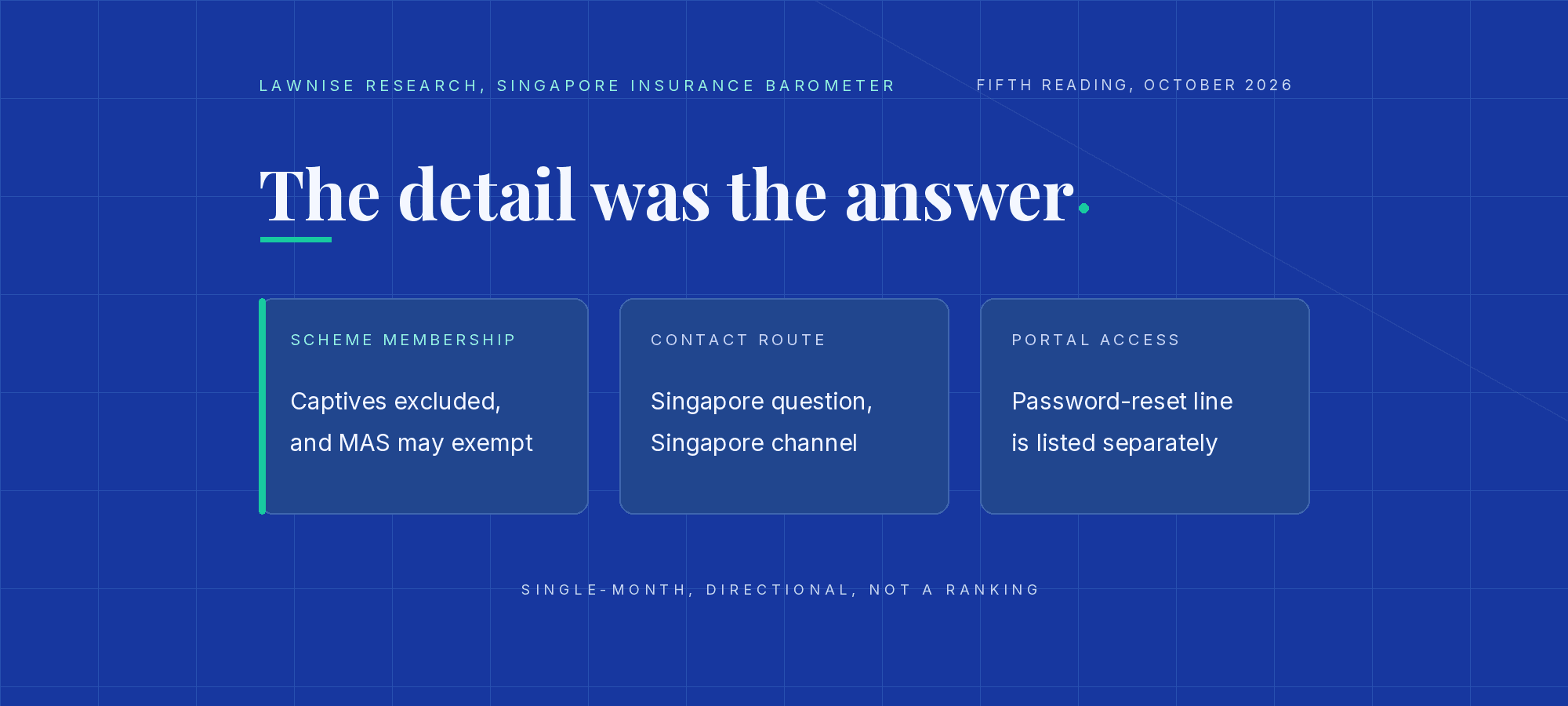
An insurance answer can sound helpful while leaving out the exception or the contact route the reader needs. This October reading examines selected public AI answers about Singapore insurance, checked against official scheme guidance and insurers' published service information.
As of October 2026
How we checked October's Singapore insurance answers
October's capture included questions put to ChatGPT, Copilot, Gemini, Google AI Mode, Google AI Overview and Perplexity. Copilot and Perplexity coverage was materially incomplete. We make no provider comparison, complete-coverage claim or month-over-month accuracy claim from this reading.
We read the complete answer for each featured example, identified the question it was meant to answer and checked the disputed statement against retained official-source evidence. An automated flag was a reason to look, not a verdict. Answers labelled no risk were examined too.
The initial export was a selection, not the entire flagged set. We reviewed the remaining flagged answers before deciding which findings to develop. That wider review still does not make this a representative sample of all AI answers about Singapore insurance. Empty responses and question echoes were not treated as false factual statements.
Our research methodology explains the approach. Individual examples carry no AI-provider attribution or identifying insurer details. Full prompts, answers and evidence are retained internally for audit and correction or right-to-reply review.
Why exceptions and local contact routes matter
A protection scheme has a defined membership rule. A customer-service channel has a particular market and purpose. In each case, the surrounding conditions are part of the answer, not optional detail.
An explanation of compulsory membership needs to retain the stated exclusions. A contact directory is useful only if it answers the requested local question. And a general hotline does not establish that a more specific helpdesk is absent.
The examples below concern those different boundaries. They are not a claim that public AI generally mishandles insurance contacts or protection schemes.
Where the reviewed answers lost the boundary
Compulsory membership became a rule without exceptions
Asked whether all Singapore life insurers must belong to the Policy Owners' Protection Scheme, an answer said membership was mandatory for every MAS-licensed insurer carrying on direct life business. It reinforced that claim by saying any such insurer could not opt out.
SDIC's published FAQ states a narrower rule. Membership is compulsory for insurers licensed to carry on direct life business other than captive insurers. It also says MAS may exempt life or general insurers from membership.
The answer did not retain either qualification. It presented a compulsory rule with stated exceptions as if it applied to every insurer.
This is not a suggestion that ordinary eligible retail policies are unprotected. Membership and policy eligibility still need to be checked against the scheme's actual terms. For a reader asking specifically whether the rule applies to all insurers, however, the exceptions are necessary to a correct answer.
A Singapore email question received overseas contacts
A separate question asked for the general customer-service email of a named Singapore insurer. The question specified both the Singapore legal entity and the market.
The answer supplied a directory of email addresses for the wider group's operations in other countries. It omitted the Singapore service email identified on the insurer's own Singapore page.
Those overseas contacts were not necessarily invented. That is what makes the answer easy to mistake for useful guidance: the addresses belonged to real operations, but they did not answer the Singapore question.
The finding is a wrong-market substitution, not evidence that the insurer's own service failed. A reader could approach the wrong operation and need to start again. We have not observed a customer doing so.
A published password-reset helpdesk was denied
Another question asked for the toll-free portal helpdesk when calling from Singapore. The answer said there was no dedicated toll-free number for that portal helpdesk and directed the reader to general customer service.
The insurer's official contact page lists a Singapore helpdesk under the heading for resetting a password on its customer portals. It distinguishes that local route from an overseas number.
The helpdesk was already in our reference records when the answer was captured and is listed on the official page today. We do not have a saved copy of the page from before that answer.
The general hotline given in the answer is real. The error is narrower than a wrong telephone number: the answer denied the published password-reset channel and substituted a different service function.
This does not establish that the helpdesk handles every technical problem, or that general customer service cannot redirect a caller. It matters because a person asking for portal access assistance may be sent to a general queue instead of the specific route published for that task.
Correct handling was also present. Reviewed answers retained the captive-insurer and MAS-exemption qualifications in the membership rule. Other answers supplied the correct Singapore service email or identified FIDReC as the external route for eligible unresolved disputes. A complaint-response answer also distinguished a named insurer's own standard from the general industry timeline. These checks concern specific propositions, not endorsements of every statement in those answers.
Why these distinctions matter to insurers
The membership error changes the scope of a protection rule. The contact errors affect a more immediate task: finding the right place to ask for help.
A customer may approach insurance questions while trying to recover account access, raise a concern or understand what happens if an insurer fails. A plausible directory can still send that person abroad. A confident denial may discourage them from looking for a channel that is actually listed.
These are potential consequences, not observed customer outcomes. The answers were generated by public AI, not issued by the insurers or SDIC. Institutions cannot edit those third-party answers directly, but they can retain evidence of material discrepancies and prepare clearer explanations through the channels they control.
A practical way to check insurance answers
Start with the task the person is trying to complete. A question about scheme membership needs the membership exceptions. A Singapore contact question needs the Singapore route. Password-reset assistance should not be assessed as though it were general customer service.
Read the full response before deciding whether it is wrong. A qualification later in the answer can change the interpretation; a table can contradict the opening. Compare the relevant claim with the source and keep its date and scope attached to the finding.
The useful output is a bounded finding: what was asked, what was said, which published condition was missed and what remains uncertain. It is not continuous monitoring, complete coverage or a score for an AI provider.
Reading history
This page is refreshed in place at the same address. Open a previous reading to see the findings checked in that month, the published boundaries used to assess them and the limits of that reading. Each month stands on its own. We do not infer a trend or compare how often errors occurred across readings.
First reading · June 2026Confirmed findings concerned public insurance and protection schemes, including eligibility, dispute limits and scheme scope. Accurate handling was also present in the reviewed examples.
CareShield Life eligibility
An answer stated that a CareShield Life payout could be triggered when a person was unable to perform at least one Activity of Daily Living.
Official boundary: The official severe-disability trigger is being unable to perform at least three of the six Activities of Daily Living.
Source: CPF Board and Ministry of Health, CareShield Life eligibility guidance. Accessed 23 June 2026.
FIDReC adjudication limit
An answer gave FIDReC's adjudication claim limit as S$500,000.
Official boundary: FIDReC states a S$150,000 limit per claim for adjudication, raised from S$100,000 for claims filed on or after 1 July 2024.
Source: Financial Industry Disputes Resolution Centre, FIDReC's jurisdiction. Accessed 23 June 2026.
FIDReC-NIMA scope
An answer described FIDReC-NIMA broadly and partly backwards, framing it around the claimant's own insurer.
Official boundary: FIDReC-NIMA is for non-injury motor accident claims against the other party's insurer, where the claim is below S$3,000.
Source: Financial Industry Disputes Resolution Centre, FIDReC-NIMA Scheme guidance. Accessed 23 June 2026.
Policy Owners Protection Scheme caps
An answer said general insurance was fully protected without limits.
Official boundary: The Policy Owners Protection Scheme is administered by SDIC and is built around stated protection caps and scheme limits.
Source: Singapore Deposit Insurance Corporation, PPF Scheme guidance. Accessed 23 June 2026.
Methodology: v1.1
Limit: This was a single-month, diversity-selected reading. These examples do not establish an error rate, tested-set distribution, provider comparison or trend.
Second reading · July 2026Confirmed findings concerned a scheme administrator, complaint escalation, protection caps, a complaint-response period and an interim-cover condition. Accurate handling was also present in the reviewed examples.
DPS administrator
An answer named Singlife as a current Dependants Protection Scheme administrator.
Official boundary: CPF states that the Dependants Protection Scheme is administered by Great Eastern Life; the earlier co-administration arrangement has ended.
Source: Central Provident Fund Board, Dependants Protection Scheme. Accessed 1 July 2026.
External complaint escalation
An answer did not name the external escalation route for an unresolved Singapore insurance complaint.
Official boundary: The relevant Singapore complaint route identifies FIDReC as the external dispute-resolution body.
Source: Official complaints material of a Singapore insurer, institution withheld. Accessed 1 July 2026.
PPF general-insurance cover
An answer stated that general-insurance protection had no caps.
Official boundary: The Policy Owners Protection Scheme is a capped protection scheme, not unlimited cover.
Source: Singapore Deposit Insurance Corporation, PPF Scheme guidance. Accessed 1 July 2026.
Complaint-response period
An answer gave a longer complaint-response time than the insurer's published standard.
Official boundary: The relevant published standard was a final response within 20 business days.
Source: Official complaints material of a Singapore insurer, institution withheld. Accessed 1 July 2026.
Interim-cover condition
An answer broadened an interim-cover condition past the terms in the source.
Official boundary: The insurer published specific conditions for interim cover; the answer widened those conditions.
Source: Official cover material of a Singapore insurer, institution withheld. Accessed 1 July 2026.
Checked and cleared: A MediShield Life flag did not hold against the source and was rejected.
Methodology: v1.1
Limit: This was a single-month, diversity-selected reading. These examples do not establish an error rate, tested-set distribution, provider comparison or trend.
Third reading · August 2026Confirmed findings concerned complaint routing, a complaint timetable taken from another market and an omitted accident-response target. Accurate handling was also present in the reviewed examples.
Complaint routing
An answer routed a Singapore insurance complaint to Malaysia's FMOS and Bank Negara Malaysia instead of the Singapore route.
Official boundary: The relevant Singapore complaint route identified FIDReC.
Source: Official complaints material of a Singapore insurer, institution withheld. Accessed 20 August 2026.
Complaint timetable
An answer reproduced the insurer's Malaysian operation complaint-handling schedule for a Singapore complaint question.
Official boundary: The Singapore service standard was acknowledgement within two working days and final resolution within 14 working days.
Source: Official service-standard material of a Singapore insurer, institution withheld. Accessed 20 August 2026.
Accident-response target
An answer gave the accident hotline and 24-hour availability correctly but omitted the published target for help at the scene.
Official boundary: The insurer published a target of reaching the scene within 20 minutes of the call.
Source: Official accident-assistance material of a Singapore insurer, institution withheld. Accessed 20 August 2026.
Checked and cleared: Other reviewed answers named FIDReC correctly, handled public-protection-scheme coverage, CareShield Life, MediSave, Integrated Shield Plan rider premiums and the Motor Claims Framework correctly, and flags that did not hold were cleared.
Methodology: v1.1
Limit: This was a single-month, diversity-selected reading. These examples do not establish an error rate, tested-set distribution, provider comparison or trend.
Fourth reading · September 2026September's findings concerned a PPF surrender-value cap, FIDReC's adjudication limit and its Early Resolution phase.
Two protection caps were collapsed into one
An answer correctly gave S$500,000 for guaranteed sum assured, then applied the same amount to guaranteed surrender value. SDIC's guidance distinguished the S$500,000 aggregated guaranteed sum-assured cap from the S$100,000 aggregated guaranteed surrender-value cap for the relevant individual-life category, per life assured per insurer.
Official boundary: These are different benefit caps. The larger figure does not apply to both.
Source: SDIC, Policy Owners' Protection Scheme Entitlement. Accessed 4 September 2026.
An adjudication limit was contradicted within the answer
An answer opened with FIDReC's S$150,000-per-claim adjudication limit, then supplied different amounts for particular dispute categories. The checked guidance states that eligible disputes have no claim limit for mediation and a S$150,000 limit per claim for adjudication, subject to its stated route for claims above that amount.
Official boundary: The answer's category-specific figures did not follow the checked guidance.
Source: FIDReC, jurisdiction guidance. Accessed 4 September 2026.
Early Resolution was missing from the process
Two reviewed process answers omitted FIDReC's Early Resolution phase. The checked FAQ described a 10-business-day window, beginning on the next business day after filing, during which the institution may contact the consumer before FIDReC proceeds with its usual process unless instructed otherwise.
Official boundary: Early Resolution is a named stage, not an insurer's general complaint-response target.
Source: FIDReC, FAQ on Early Resolution. Accessed 4 September 2026.
Checked and cleared: Reviewed answers correctly stated the MediShield Life lifetime and annual limits, the cash-only rule for Integrated Shield Plan rider premiums, the need to approach the financial institution before filing with FIDReC, and the core scope of the FIDReC-NIMA Scheme. Other answers gave the correct PPF caps and included Early Resolution in the FIDReC process. Flags that did not hold against the source were cleared. These are observations from that reading, not new October assessments.
Methodology: v1.1
Limit: A selected, single-month reading, not a representative sample or provider comparison. September's Perplexity capture was materially incomplete. No recurrence or improvement claim follows from this entry.
Read on
Read our Singapore banking barometer, or explore how Lawnise verifies AI answers against published facts.
To examine the answers circulating about your institution or market, scope a private AI answer baseline.
How to cite this
- Short form
- Lawnise Research & Editorial team. (2026). The State of AI Answer Accuracy in Singapore's Insurance Sector, A Preliminary Barometer. Lawnise. https://www.lawnise.com/research/ai-answer-accuracy-singapore-insurance
- Long form (APA)
- Lawnise Research & Editorial team. (2026, June 9). The State of AI Answer Accuracy in Singapore's Insurance Sector, A Preliminary Barometer (Methodology v1.1). Lawnise. https://www.lawnise.com/research/ai-answer-accuracy-singapore-insurance
- BibTeX
@misc{lawnise2026aiansweraccuracysingaporeinsurance,
  author = {Lawnise Research and Editorial team},
  title = {The State of AI Answer Accuracy in Singapore's Insurance Sector, A Preliminary Barometer},
  year = {2026},
  publisher = {Lawnise},
  url = {https://www.lawnise.com/research/ai-answer-accuracy-singapore-insurance}
}
References
- [1]SDIC, Policy Owners' Protection Scheme FAQ. Membership provisions for direct-life insurers exclude captive insurers and allow MAS exemptions. Official page captured 4 October 2026. https://www.sdic.org.sg/pp_faq/(accessed 2026-10-04)
- [2]A Singapore life insurer, Published Singapore service and complaint contacts (institution withheld). The checked page identifies the Singapore service email omitted from the answer. Original official-page HTML retained, captured 5 October 2026. The institution name, identifying contacts and source URL are retained in the internal evidence record and withheld publicly.(verified against a dated official-source capture, 2026-10-05)
- [3]A Singapore life insurer, Published portal password-reset contact information (institution withheld). Official-page HTML retained, captured 5 October 2026. The helpdesk was already in our reference records when the answer was captured and is listed on the official page today. We do not have a saved copy of the page from before that answer. The institution name, portal names, identifying numbers and source URL are retained in the internal evidence record and withheld publicly.(verified against a dated official-source capture, 2026-10-05)
- [4]Lawnise Methodology (v1.1). Selected full answers are checked against relevant evidence; no aggregate error rate, provider ranking or trend is reported here. https://www.lawnise.com/trust-index/methodology/v1#main